
Films: Who’s Making England’s Crop Circles?
Who’s Making England’s Crop Circles?
The Department of Information
Available on YouTube
‘I am a circle maker. The first ever crop circle I made was when I was 13 years old We went to visit the circle the next day after it was made. And we all sat down and this real hippie guy; he was like, “I can feel the energies that have made this circle like the almighty beings.” We’re like, oh yeah, we’re those aliens. But you can’t really say that to them, can you?’
So, just who is making England’s crop circles? Well, in this 37 minute, independently produced documentary, The Department of Information attempt to find out and, well, fail pretty hard at answering the question.
Let’s not kid ourselves, the producers surely saw which active hoaxers have been screaming for attention since Facebook was a thing. But sitting around in a Somerset garden centre or Dorset transport cafe with the usual suspects isn’t too much fun.
Instead, the film makers seemingly wanted life and vibrancy and so followed the well-trodden trail to the conjoined villages of Alton Barnes, Alton Priors and Honeystreet in Wiltshire. It’s here where farmer Tim Carson wearily reflects on his involvement with the circles and why the things now get cut. And it’s here that Monique Klinkenbergh and her calm Crop Circle Visitor Centre look over to The Barge Inn and its associated camping, crusties and craziness.
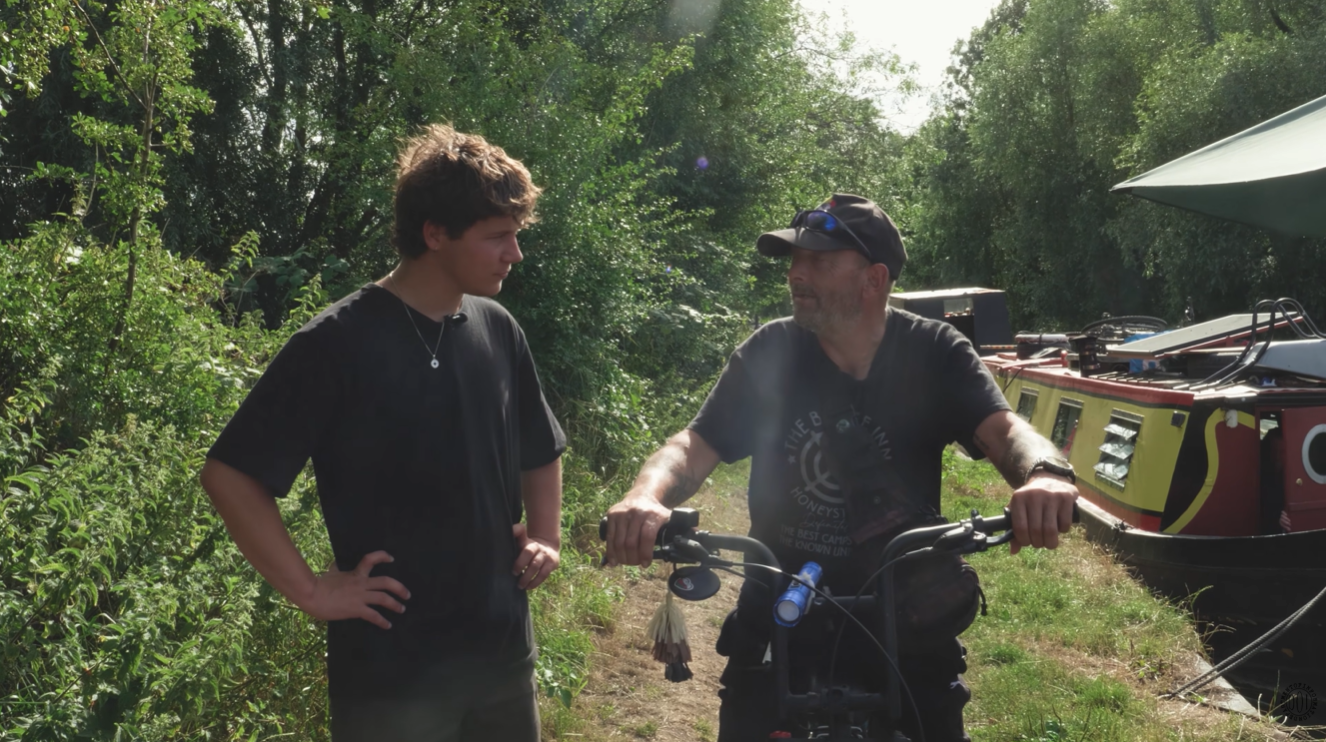
We can only imagine the horror the producers experienced when they turned up at the pub to be greeted by Hope, the bartender who knew nothing about crop circles and hadn’t seen one in years. Then there was Charlie, a cantankerous old boater without a good word to say about the circles and their makers. We’re not surprised as The Barge really hasn’t been part of the croppie landscape for at least a decade now. But the film makers don’t give up. Amidst the face tattoos, piercings and rotten teeth on the show, the camera turns to Sam the chef and his dreams of one day making a crop circle. Fortunately, Dolphin (an unsettling man on a bike) and his quivering voice are more insightful. When asked what he makes of crop circles, he sagely replies, ‘If I knew shit, I wouldn’t give it away. Yeah man, look what happened to Santa Claus. No-one believes that shit anymore, do they?’
It’s a moment of lucidity that floats in resonance with an earlier sequence where crop circle tour guide Eric Verkuijlen explains, ‘What most of the people like the most is the mystique around [the crop circles], the mystical feeling, and because we don’t know what or who has made the crop circles.’
The two men are poles apart. Eric all polite and reserved, Dolphin all rough and ready; but they are both right in what they say. Crop circles need mystery to survive. Therefore, it is with grim irony that Matthew Williams is hauled before the cameras. ‘I’m one of the circle makers,’ he explains, before quickly making an important correction: ‘I used to be.’
Retired or otherwise, it’s the same old Williams with the same old script, slipping in a mention of his prosecution for circle making before complaining about the Carsons and the practices of crop circle researchers. Money is at the root of it all. Williams goes on to reassure the presenter that one more documentary about human circle makers won’t cause further damage to the phenomenon, and to an extent he’s right. However, he’s said more than enough in the past, and it’s probably only Klinkenbergh’s inexhaustible politeness that keeps her from mentioning his name when she’s pressed as to why crop circle numbers are in steady decline.
So we have a snapshot of what crop circles are and how they have affected one corner of Wiltshire. We also now know that there is tension between circle makers, researchers and farmers. At this point, it’s easy to think the focus of the documentary, that question, has been lost: Just who is making England’s crop circles? Are the cavalry on the way up from somewhere, anywhere, to salvage things?
No, not quite. To avoid a complete failure in identifying the circle makers, a short segment in the final quarter of the film focuses on a woman in a short sleeved top, her face blurred out in post-production. ‘I am a circle maker,’ she confidently asserts before bursting into a giggle. Is it a laugh of embarrassment because she’s talking herself up following a couple of nights with a plank in the distant past? Whoever she is, I have no idea. Whatever the truth, she’s blurted out what the film makers wanted to hear. And that’s her over and done with in a minute, even though she had no right to be using the present tense.
That the title of the documentary hinges around such an inconsequential appearance is bothersome. For a film seeking to provide insight into who is making crop circles in the contemporary world, it fails at the simplest level. It was always going to do so, because no genuinely covert circle maker would be part of such a project. These people have everything to lose and nothing to gain from the experience of an independent documentary. They should be more selective. Were it the late 1990s then things would be different, as Grant Wakefield showed in his Croppies documentary, giving airtime to the likes of Circlemakers.org.
Furthermore, this film isn’t a 21st century take on Wakefield’s look at the people involved with the circles. The circus already left town. And that’s the problem here: The Department of Information turned up a decade too late and tried to make a crop circle documentary in an area where circles are no longer welcome, where there are no active circle makers and very few croppies. Early on, you would have thought the producers would have realised they were picking through the dregs at the bottom of the bin liner. But they ploughed on and this is the result.