
Films: Investigating Crop Circles In the Field
Investigating Crop Circles In the Field
Channel Freax
Available on YouTube
If you’re an investigative YouTuber seeking to delve into the weird and wonderful, crop circles are an inviting and easy target. We don’t bother covering most of these short films for various reasons, but earlier this year we couldn’t help ourselves when we saw The Department of Information’s thoroughly puzzling Who’s Making England’s Crop Circles? Having been made at some point during the worst season on record, it left us wondering if the phenomenon had become the domain of shuffling, shoe-gazing crusties, halfwits and fantasists, some of which clearly had drug related issues. As sorry as some independent journalism can be, the film completely missed the point it had set out to address.
Thankfully, the 2026 season restored a good amount of our faith and we were curious when we were made aware of another circles documentary, Investigating Crop Circles In the Field. This too was filmed during the awful, near-barren 2025 season by a new pair of documentary makers, Channel Freax. Rather than turning up, balls out, in Alton Barnes and putting the boot in (which they probably considered at some point, let’s be real!), Channel Freax took a different approach. They put the sensationalism to the side and created a solid, old-fashioned, outsiders’ take on crop circles.
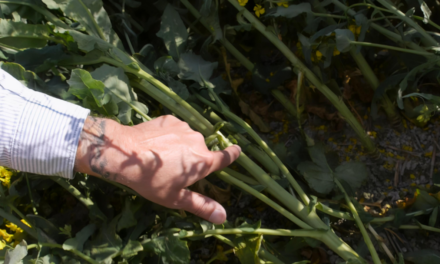
Inevitably, all but the most blinkered film-maker will discover the formations are nothing without people on the ground to interpret them, and that’s exactly what happens here. First up are experienced talking heads Andy Thomas and Barry Reynolds. We’ve a lot of time for both men and they’re clearly experts in diplomacy. It was fascinating to see Barry pull out some crop samples—blown nodes included—to support his perspective that he can’t be certain who or what is making the circles.
However, it’s the ordinary rank and file croppies that speak to us most and in these moments we see glimpses of human vulnerability:
There’s a wonderfully camp, infectiously happy street trader who talks about codes and visitors from the Pleiades. We chuckled at the semblance of a half-smile from the presenter as he was told, sincerely, by Australian tourist Katina that she lay in the Sutton Veny circle ‘Because I always like to connect with Mother Earth.’ And we just love the segment with Flemish croppie Bart VsdC in the Crop Circle Visitors Centre and Exhibition who hilariously demeans Scotland as ‘rough’ compared to England, ‘the land of milk and honey’.
The crew move away from Wiltshire to Glastonbury and the annual Symposium. Though it may seem a slightly odd place to go when crop circles are just one of many things on the table, the venue provides us with the most meaningful words from the film. They come from event organiser Jason Porthouse:
‘One of the things I find interesting about the phenomenon is it’s being okay with uncertainty. You know, one of the things we tend to do as humans is we always look for answers. We’re always kind of, like, keen to get everything sort of pinned down. And that’s kind of a lot to do with the sort of pinned down. And that’s kind of a lot to do with the sort of ascendancy of science and the rational. I think there’s something really magical about mystery and not knowing and not having all the answers to things because it leaves space for magic in the world.’
The crux of this documentary is that crop circles speak to different people in different ways. Porthouse’s magic is not a one-size-fits-all. Magic comes in various shades of colours, including grey. Barry appreciates the plant anomalies he can find during on-the-ground investigations, the street trader likes his Nordic extraterrestrials, Katina connects with Gaian energies. The film shows that the binary ‘alien-made versus man-made’ dichotomy which was pushed for so long by the media has become redundant, if it ever really existed in the first place.
Some will argue that the film-makers have, deliberately or otherwise, overlooked those human circle makers who so desperately want to be heard. But we see that as a positive; one of the reasons why 2025 was such a shocking season was because the clowns had taken over the circus. They’re not needed in this space.
Ultimately, there’s nothing groundbreaking here, nothing particularly exciting, but this documentary takes us back to what it was like to be one of those croppies who could and would just go out, visit circles and chat with others who had no desire to make you ‘wake up’ to this, that or anything else. It’s this croppie zeitgeist that Investigating Crop Circles In the Field has so gently captured. At this point in crop circle history that’s a good thing.