

Three Circles: 1991
INTRODUCTION
Three Circles is a short history of crop circles. Each installment covers a specific period of time and features three circles important to the development, evolution and public perception of the phenomenon.
1991 marked the end of the golden era for cerealogy. Hearts would be broken, reputations already damaged the previous year would be near enough destroyed, and the public’s relationship with the phenomenon completely altered. Yet there would be excitement and fun along the way, and whilst the antics of Doug Bower and Dave Chorley would make front page news around the world, croppies were given two completely unexpected looks at what the phenomenon had in store.
17 JULY 1991: BARBURY CASTLE, NR SWINDON
The previous year, 1990, will always be remembered as the pinnacle of crop circle history. From nowhere, the phenomenon evolved from simple rings and circles into the pictogram; the most famous of which was laid down in East Field, close to the twin villages of Alton Priors and Alton Barnes. Then there was the dramatic, televised scene of Colin Andrews and Pat Delgado discovering they had been hoaxed during the Operation Blackbird cropwatch. Hopes that the season would conclude with something else new and exciting were never realised. August fizzled as the combines started to bring in the crop. One of the final acts in Wiltshire was the addition of a smiling face next to what remained of the heavily trodden East Field pictogram.
1991 began with little in the way of shock. Simple circles and pictograms remained abundant, the latter sometimes being embellished with what appeared to be antennae to forge a new style called the insectogram. Avebury and its downland surroundings seemed to be a focal point. As John Michell noted in issue 4 of The Cerealogist:
‘Cerealogists made their headquarters at the Waggon & Horses Inn, a few hundred yards from Silbury Hill, and all around them appeared an array of pictograms, developing and changing forms throughout the season. Driving across the Marlborough Downs, one could view a number of different examples without leaving the road.’

Photograph by George Wingfield.
Six miles north east, on 17 July, an innovative new formation turned up in a field at the base of the Barbury Castle hillfort. Unmissable from above, the design was constructed around a flattened central circle and two concentric rings. The outer of these rings was crossed at six separate points by a large triangle. Three straight lines radiated from the central circle out to the vertices of the triangle. Each of these corners was incorporated into distinct embellishments. The first was a simple ring, the second a circle containing six curves. The third, a broken spiral centred on a tramline.
Being such a break from the archetypal single-axis pictograms, the new formation attracted superlatives from croppies and cerealogists. Peter Sorensen suggested it was ‘perhaps the most significant crop circle of all’, whilst Stuart Dike (later of the Crop Circle Connector) hyped it as the ‘mother of all crop circles’. Criticism would also follow. Terence Meaden, whose plasma vortex theory competed for media time up against paranormalists Pat Delgado and Colin Andrews, declared it fake and incompatible with his ever-evolving theory. Members of the Wessex Skeptics learned of hearsay from one local resident that the perpetrators’ vehicles may have been discovered close to the edge of the field. Documentary producer John Macnish detailed this in his book Cropcircle Apocalypse:
‘After [the Wessex Skeptics’] visit they began chatting to a lady selling tea at a bungalow on the farm. She told them about a conversation she had had the morning after the formation appeared with two patrol guards. The two soldiers had been patrolling the boundaries of the nearby military base (now closed) at about 2.00am on 17th of July when they noticed two cars parked at the end of a track. They were suspicious and watched for a few minutes to see if anyone was about. The cars were empty, the patrol guards simply recorded their registration numbers and continued about their business.’
Nobody has come forward to claim the enigmatic formation at Barbury Castle. Since the initial fuss over its appearance, it has become something of a damaged icon. Diagrams of the circle, like those pictorial representations of so many other formations, mask its imperfections. The most notable of these is the misalignment of the triangle’s corners. One side has a notable bulge as it has been redirected to avoid hitting the innermost ring. Nonetheless, this formation stands out as ambitious, adventurous and hinted at the geometric styles that would begin to take hold of the phenomenon later in the decade.
12 August 1991: Ickleton, nr Cambridge
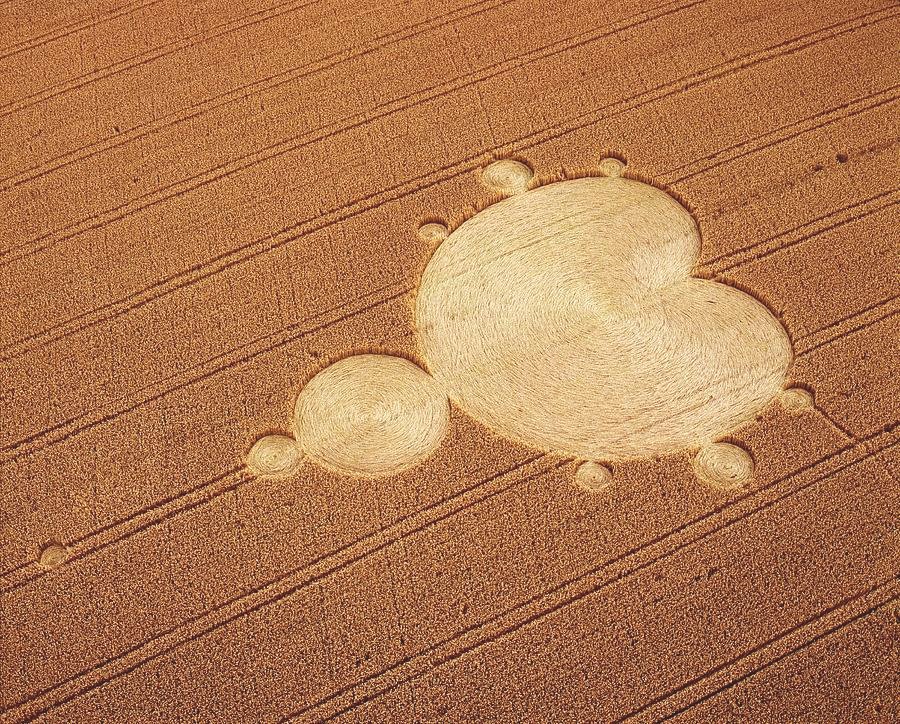
The 1991 'Mandelbrot Set' fractal circle. Photograph by David Parker.
The New Scientist magazine of 11-17 August 1990 featured a short piece of correspondence from Wiltshire based reader Martyn Hughes:
The formation of corn circles are growing in complexity each summer. How long before we see a complete Mandelbrot set?
Maybe Mr Hughes possessed the gift of foresight. Almost a year to the day after the letter was printed, pilot Stephen Cherry-Downes was flying over the Cambridgeshire village of Ickleton when he spotted the most adventurous and extraordinary crop circle to date. Its form consisted of a large cardioid heart, flanked by small side circles and sat atop two lower circles. It was nothing less than a cerealogical vision of the Mandelbrot set fractal. More importantly, it was a formation so far ahead of its time that nothing similar would follow for another half a decade.
On the ground, a survey by Beth Davis and two other members of the Centre for Crop Circle Studies revealed the formation to be very slightly weighted towards one side. Not that anybody noticed. The media was far more interested to know just what mathematician Benoit Mandelbrot thought of it (‘[I am] very pleased to hear of the theory taking root … I can’t wait to see what the next one will look like’) and who — not what — was responsible.
As so often happens today, discussion swirled around the identities of the alleged perpetrators. No names, just their interests or employment. On this occasion, students from Cambridge University replaced the ubiquitous young farmers and drunks. If this was a first time venture into crop circle making, the results remain extremely impressive to this day.
September 1991: Sevenoaks
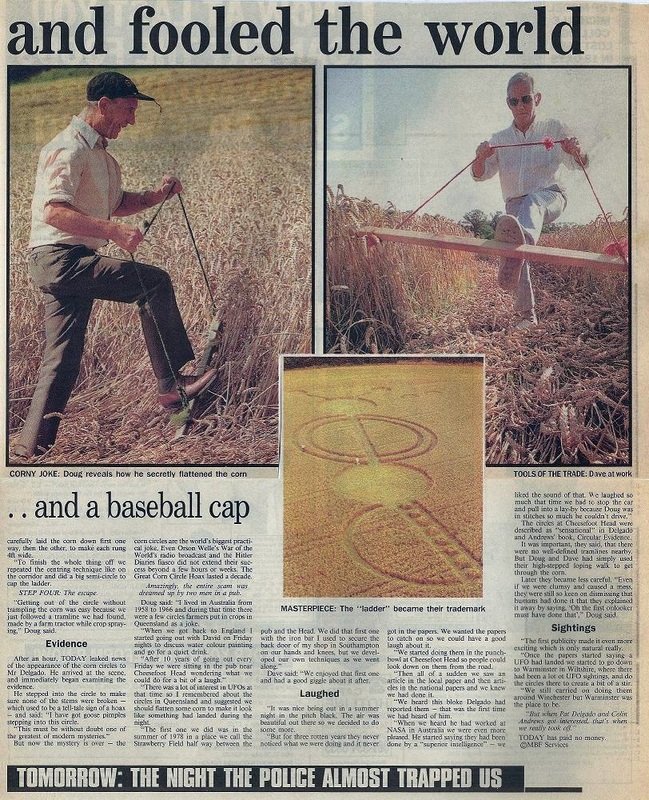
The two men worked their way around the circle under the watch of the camera lens. To the outsider it must have been a peculiar scene. A couple of sixty somethings, shunning the fad of comfortable modern sportswear, were purposefully striding a circular path around a wheat field, working up a sweat as they went. The younger looking of the pair looked every bit the portrait of the early nineties coach driver: grey slacks, white shirt and practical sunglasses. His companion was leaner and wiry. He had the air of one of those locals you’d hear murmuring about real ale under the horse brasses on a Sunday afternoon: brown trousers, off-white shirt with rolled up sleeves and everyday shoes. The baseball cap, with the odd wire monocle, was a peculiar, out of place accessory.
Both men worked with their own archaic tool to crunch down the overripe wheat ahead of them: a long wooden plinth attached to a rope. Front foot on the wood, reign lifted, a long stride … the brittle stems pressed down to the soil, grains leaking from each and every head.
When they had finished, the men stepped back to accept the praise and congratulations from their chaperones. Two fit though otherwise unremarkable men, David Chorley and Douglas Bower, had just completed a demonstration of their crop circle making abilities for TODAY newspaper, a British tabloid daily. This was the crop circle about to change, some would say destroy, cerealogy forever. It was odd that it should have appeared in the unlikely surroundings of Sevenoaks in Kent, well away from the crop circle prone fields of Wiltshire and Hampshire.
Bower and Chorley’s work was an example of the insectogram style. As ludicrous and maybe even childish as the name suggested, the first insectogram had appeared close to the small Hampshire village of Upham three months earlier. Just two days later, another was discovered by Winchester resident Matthew Lawrence on Chilcomb Down. Built around the pictogram style that had dominated the fields during the previous year, it was the addition of antennae to the ‘head’ of each formation that gave the insectograms their name. The Sevenoaks demonstration would also feature two other hallmarks of the 1991 season. The first was a pair of Ds off to the side of the ‘head’, a signature for Doug and Dave. The second, a ladder shape flattened into the end of the formation’s lower ‘body’.
To less innocent eyes in the 21st century, the insectograms seem to be Bower and Chorley’s attempt to push the credibility of cerealogy to its limits. The pair were almost certainly having fun, wondering if their next creation would be the one that finally led cerealogists to see through their shenanigans. It should have been the July insectogram at Cheesefoot Head, outside Winchester, that put things to bed. It looked like a pre-school child’s representation of a curious snail, its head peering up from its shell. But no. As if to press the point home, TODAY brought in well known cerealogist Pat Delgado to warmly praise the Sevenoaks work as the real deal. On the following Monday, 9th September, Delgado would be humiliated by the tabloid; the duped, easily fooled ‘expert’ serving as the fall guy in a story that would break the truth about the circles to the entire world. Bower and Chorley became headline news in print and on television. Household names.
Although Doug and Dave would not be opening public eyes to human involvement in circle making — the perpetrators of 1990’s hoax at Westbury during Operation Blackbird had shattered any illusions — they would be the first to offer a largely consistent backstory and demonstrate their construction skills to the wider world. Not only this, they claimed to be the originators, the inventors of the phenomenon. Their everyman status made them irresistible.
It has never been entirely certain why the original circle makers decided to go public. In his book Round In Circles, Jim Schabel suggests Bower and Chorley had been spooked in June after they were stopped by police shortly before they started work on an insectogram:
‘Doug and Dave realised that they probably wouldn’t get away with it again. Not only were the police alert to circles hoaxers, but the number of cropwatchers was increasing every summer. The odds were starting to weigh against them.’
Other alternatives have been put forward. Bower told John Lundberg of his fear that Colin Andrews would have asked the government for public money to investigate crop circles. In the same interview, published in The Field Guide, Bower claimed the ‘real reason’ the pair broke cover was because Chorley’s health was failing. Schnabel also provided an alternative theory, namely that Doug and Dave had become tired of seeing cerealogists such as Delgado and Colin Andrews profit from their hard work. We wonder if another factor was the appearance of the circles at Barbury Castle and then Ickleton earlier in the year, as well as 1990’s large pictogram in East Field. These were the attention grabbing circles at the time, not those by Bower and Chorley.
Whatever the truth, Doug and Dave had let the cat out of the bag and things would never be the same. Innocence was dead within cerealogy. The subject was now entering the wilderness of turmoil, paranoia and self doubt. A new and unhappy chapter was about to begin.
i think i know what you know.