
Croppie Gossip: AI Trouble In The Camel Enclosure

Ten Watt AI Tiff
TL/DR: Team Ten Watt hoaxer Dene Hine had a blow-up with his peculiar agent, Hamish Jacobs over the use of AI within the sewer group on Facebook. Jacobs’ rage-quit lasted longer than the collective duration of all of Hine’s retirements: 8 minutes.
For more, read on, though be aware the article has been generated with the ironic contempt it deserves. Otherwise, scroll down to the next section for more on that Breen fellow and a terrible revelation for crop circle makers:
An online debate between social media admin Dene Hine and user Hamish Jacobs quickly escalated from a discussion about a historical UFO sighting into a heated clash over the integration of artificial intelligence in online discourse.
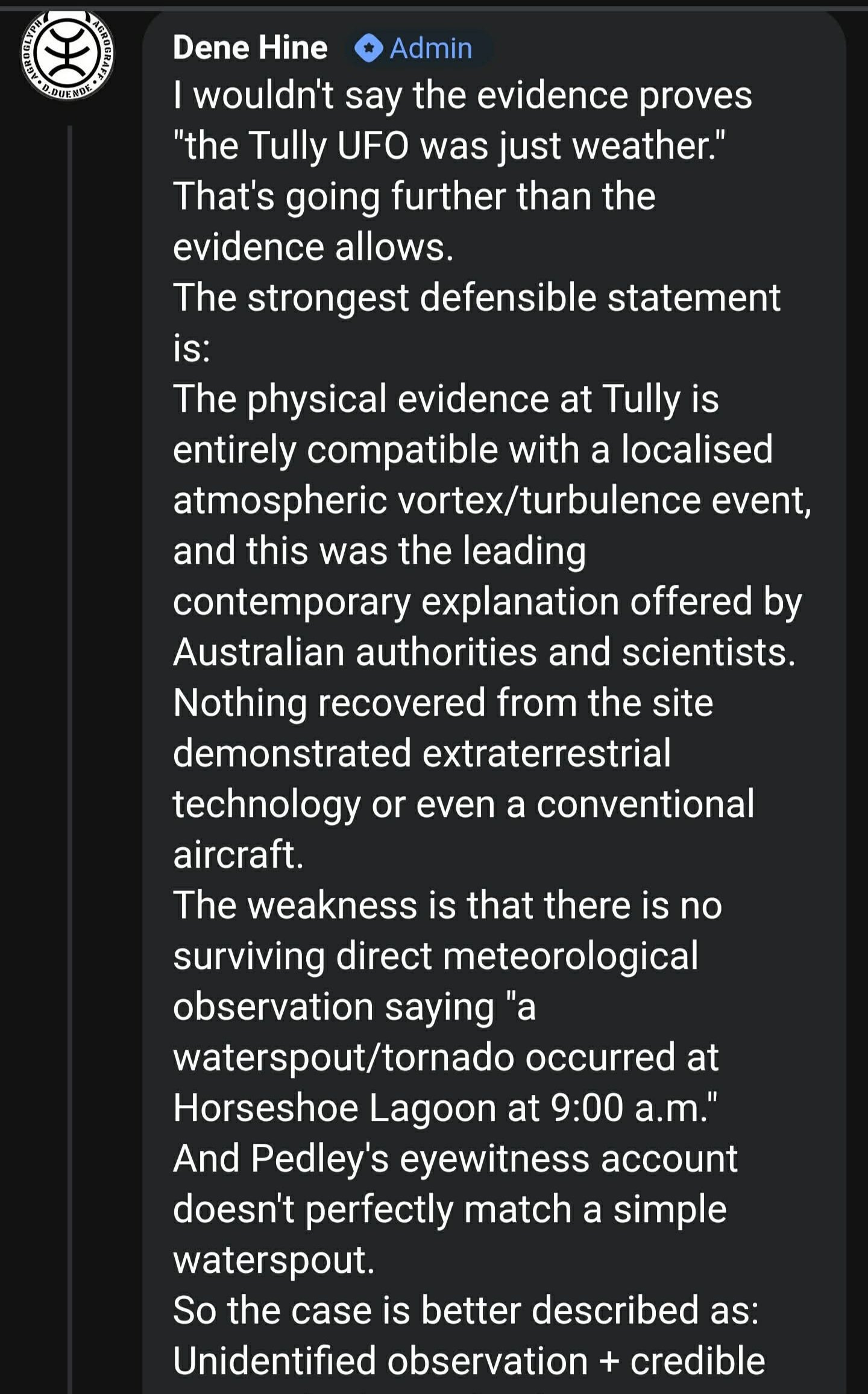
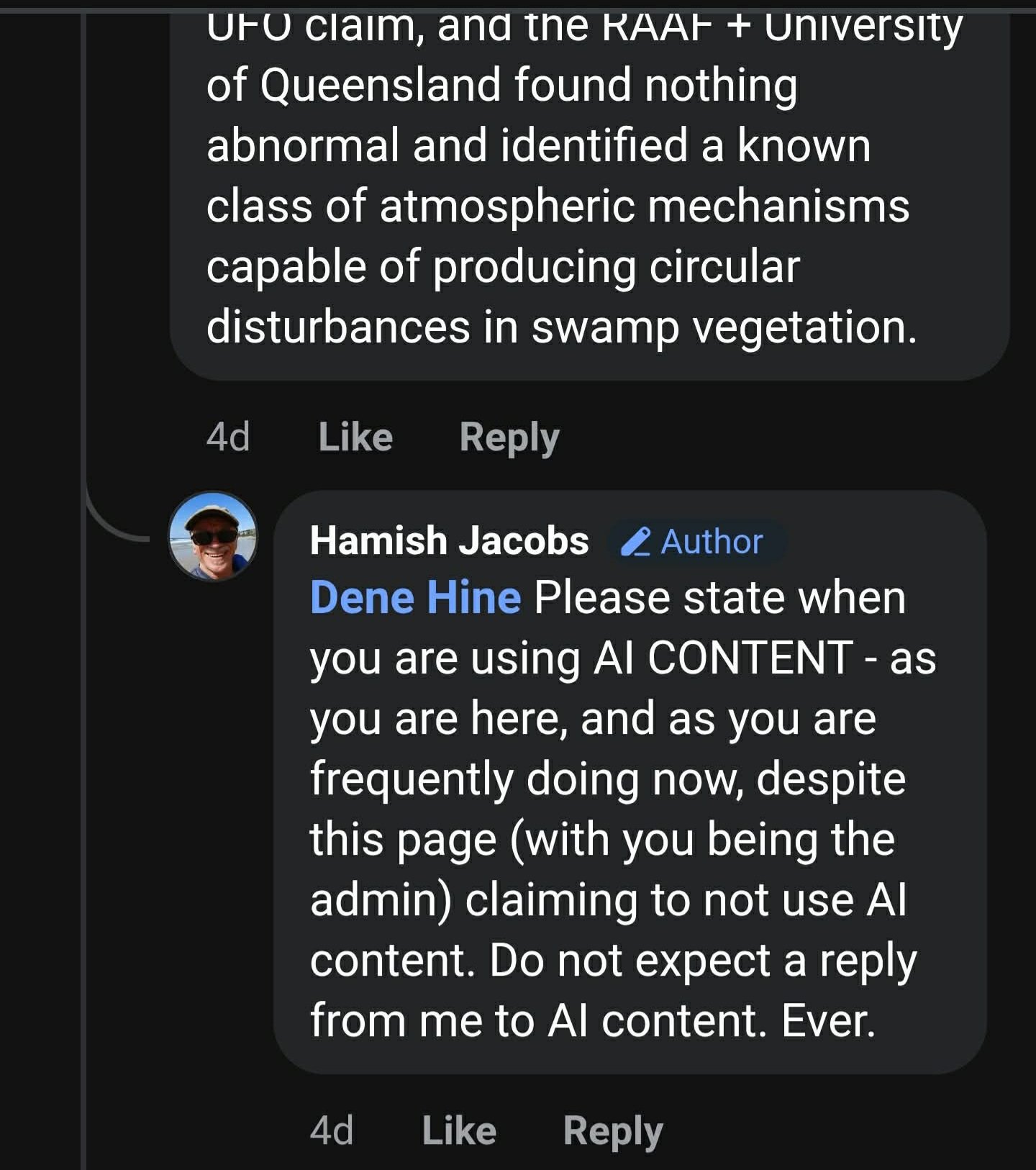
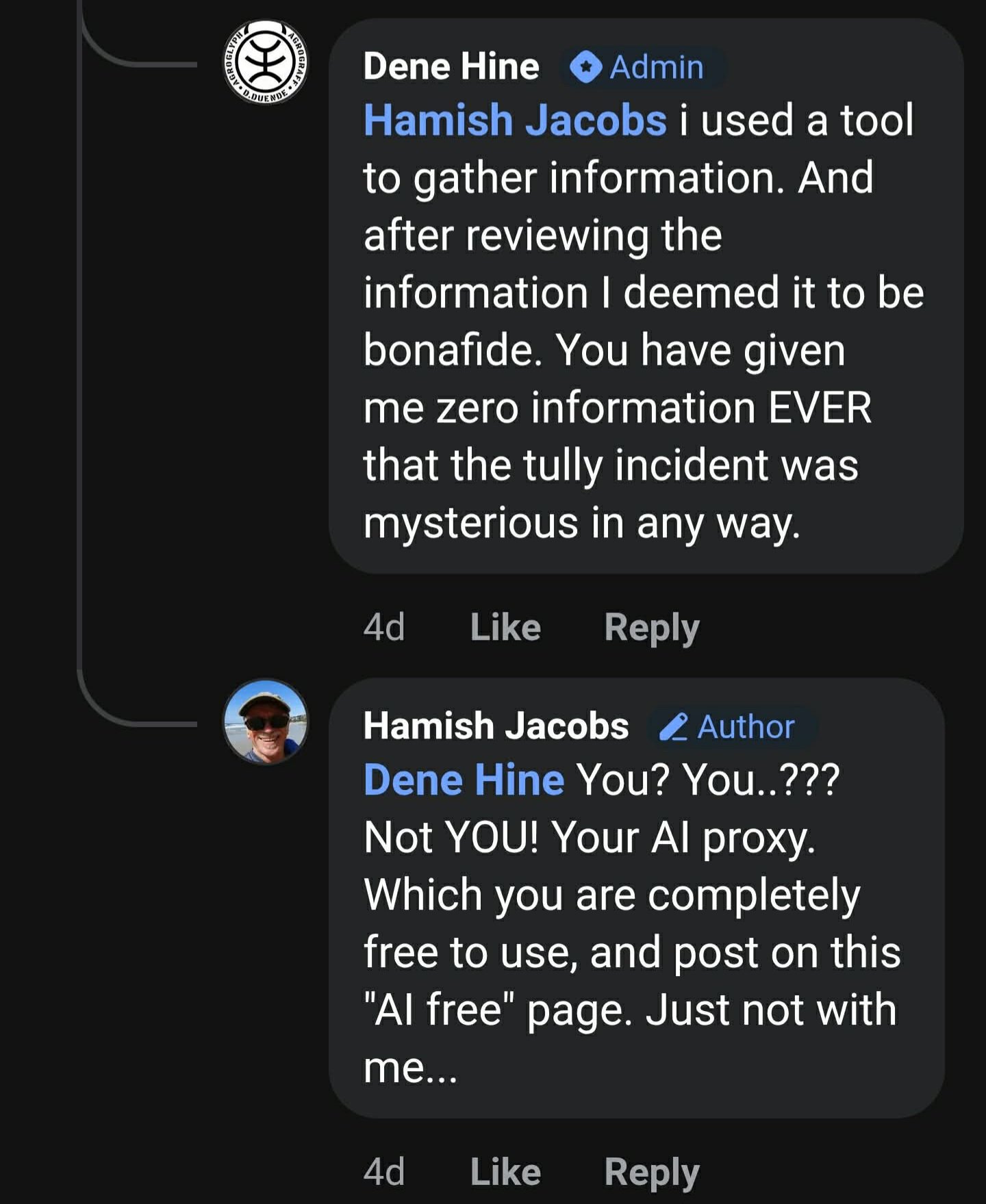
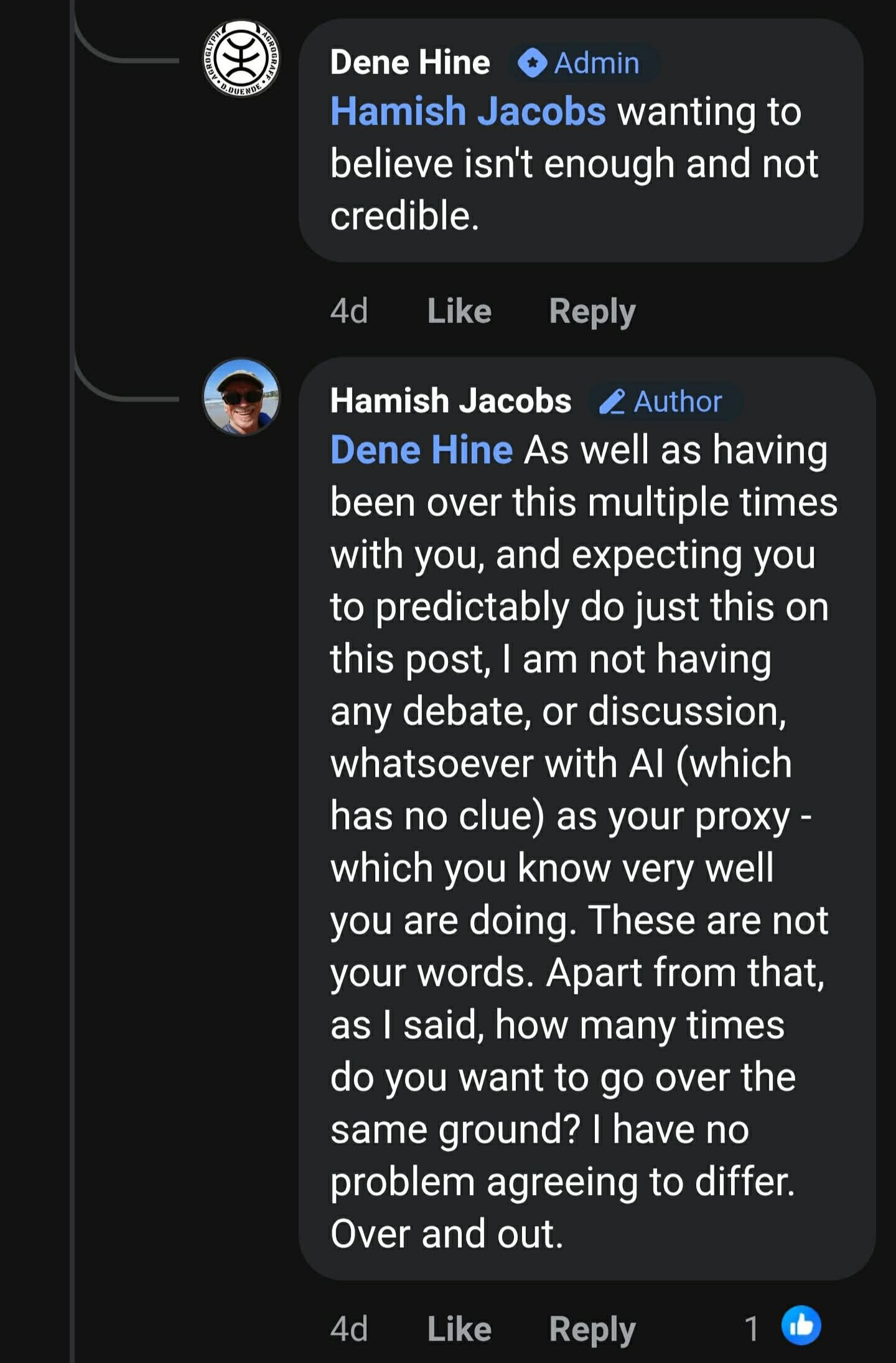
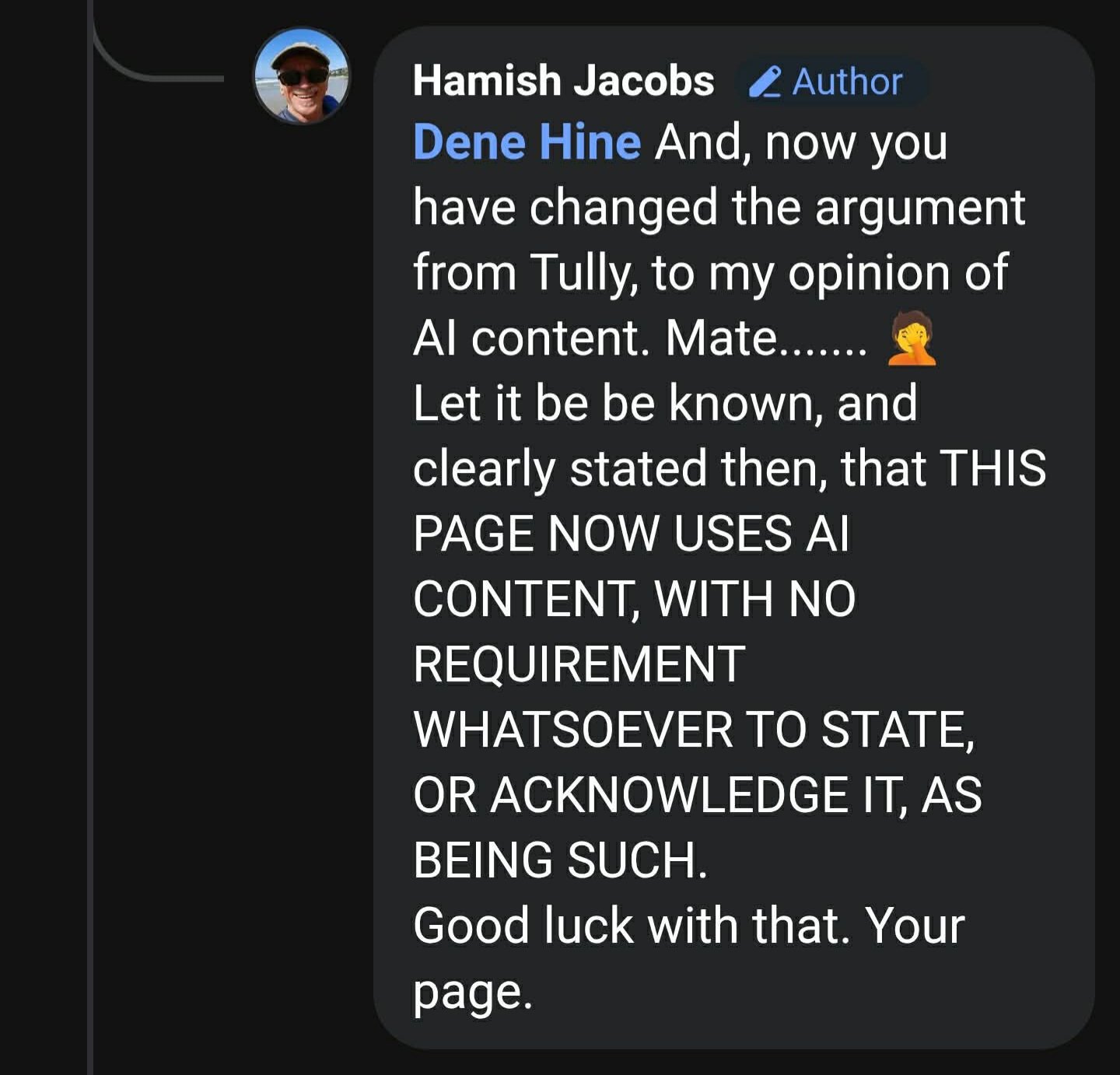
The exchange began with a debate over the famous Tully UFO incident, a 1966 Australian mystery involving a circular area of flattened reeds in a Queensland swamp. Hine argued that the evidence does not definitively prove the Tully event was ‘just weather,’ but maintained that physical evidence remains entirely compatible with a localized atmospheric vortex or turbulence event. He noted that Australian authorities and scientists found no proof of extraterrestrial or conventional aircraft technology, though he acknowledged the weakness of lacking direct meteorological observations at the exact time and place.
Jacobs expressed fatigue with going over the same ground, accusing Hine of relying on belief rather than credible, mysterious evidence.
The conversation sharply shifted when Jacobs called out Hine for utilizing artificial intelligence to generate his arguments. Jacobs demanded that Hine disclose when he is using AI content, arguing that these responses are ‘not your words’ and refusing to debate an ‘AI proxy’ that has ‘no clue’.
Hine defended his method, explaining that he used a tool to gather information and independently reviewed it (most likely, just accepted it as true) to ensure it was ‘bonafide’ before posting.
As tensions mounted, Jacobs declared ‘over and out’ and stated he would no longer reply to AI-generated content. In response, Hine fired back by pointing out that the argument had veered away from the Tully incident entirely. Jacobs retaliated by criticizing the page’s changing stance on transparency regarding AI usage.
The exchange highlights a growing friction in online research communities: the line between leveraging AI as an information-gathering assistant versus authenticity in community debates.
Weighing in on the existential perils confronting cerealogical studies, The Croppie offered an expansive and scathing critique regarding the insidious creep of automated models into historical debates and the study of formations:
‘To invite artificial intelligence into the delicate discourse of cereaology is to introduce a Byzantine labyrinth of hollow syntax that evacuates all genuine human inquiry. Relying on generative proxies to parse historical anomalies like Tully reduces authentic debate to a funereal exercise, wherein critical thought is buried beneath layers of algorithmic mimicry and sterile, unexamined artifice.
‘Beyond mere conversational discord, the future integrity of our entire subculture is now actively imperiled by this computational plague. We are witnessing the systematic evisceration of fieldwork, replaced instead by a homogenized digital compendium manufactured by machines that have never walked a furrow or felt the tactile mystery of flattened stalks under an empyrean summer sky. You’ve read, Citizen D’s book, ya? These predictive text engines do not investigate anomalies; rather, they assimilate our shared heritage, rendering nuance down into statistical averages propagated in increments of cold, soulless probabilities. If we surrender our intellectual stewardship to these synthetic intermediaries, the profound strangeness of the phenomenon will be utterly sanitized, leaving behind a hollowed-out simulacrum where true wonder goes to die. It’ll be like the fields of Somerset and Dorset each year.’
Observers of the exchange might characterize the interaction through the lens of academic futility. Mike Farrow of the Canvas of Gold website added his own perspective in his really not-AI generated voice and words:
‘Analyzing the dialectical impasse between a world-class artist and leading historian regarding mid-century botanical disturbances and synthetic proxies resembles an exercise in profound redundancy. Where is the evidence Mr Jacobs? Where is the evidence, Mr Circlemaker? The discourse will collapse into an unproductive recursive loop, yielding negligible epistemic advancement for either participant. Ultimately, the confrontation highlights the growing societal anxieties surrounding authenticity, epistemic authority, and the deployment of large language models within traditional peer discourse. Wake up everyone!’
Right on.
Is Billy For Real?
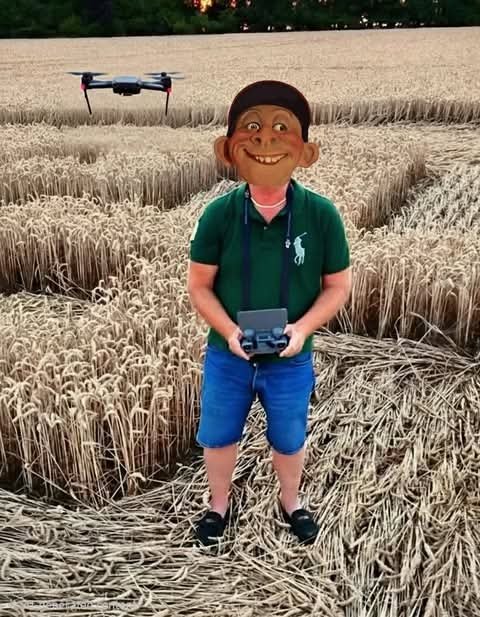
Billy Breen, hanging around crop circle sites from January to December.
Attention-seeking Ten Watt photographer Mark ‘Billy’ Breen has been enlightening his Facebook followers on the prospect of future designs before the end of the year. After a visit to the remains of the poppy formation at Etchilhampton, he stated:
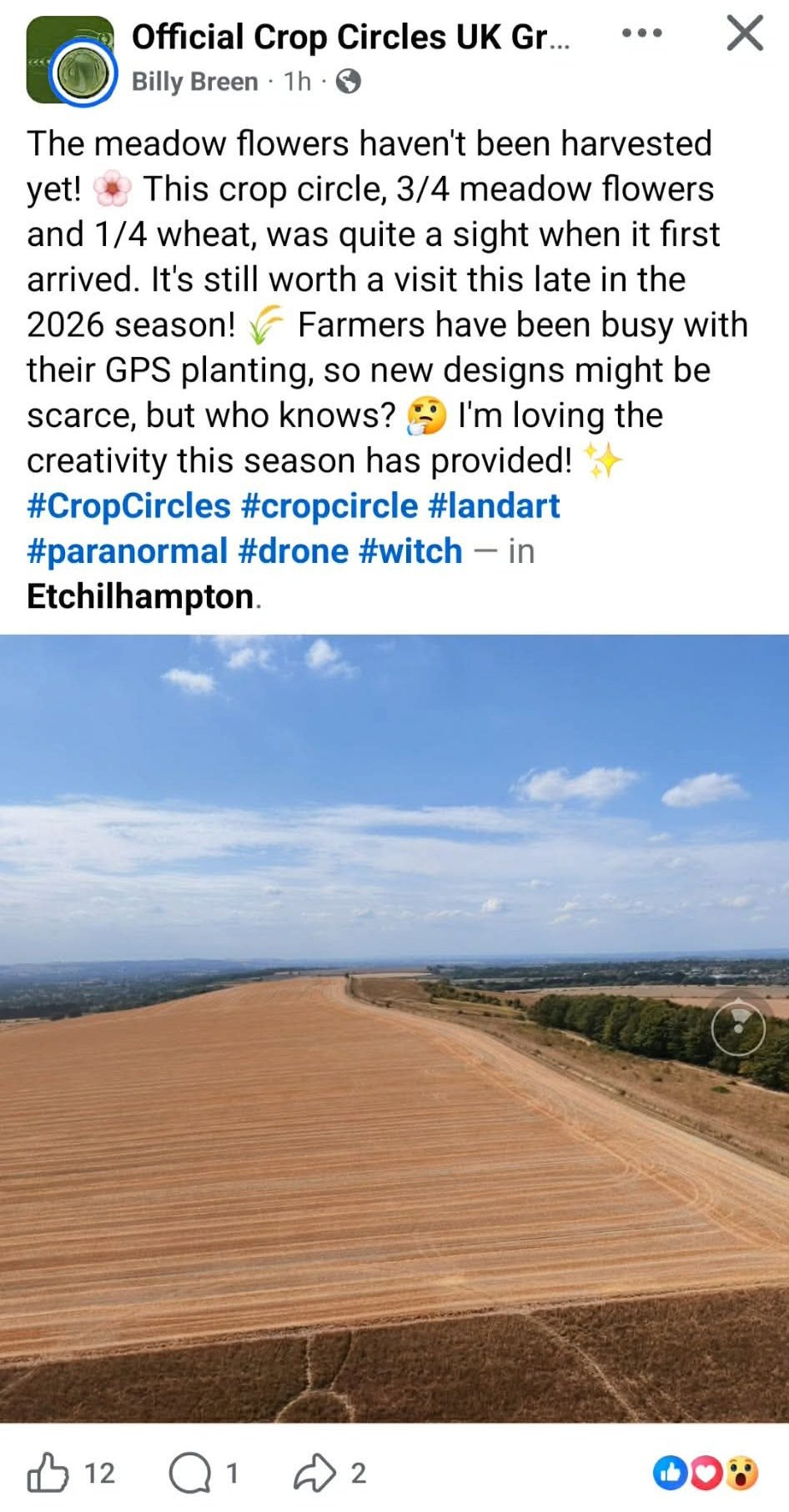
The meadow flowers haven’t been harvested yet! This [Etchilhampton] crop circle, 3/4 meadow flowers [they’re called poppies, Mark] and 1/4 wheat, was quite a sight when it first arrived. It’s still worth a visit this late in the 2026 season. Farmers have been busy with their GPS planting, so new designs might be scarce, but who knows? I’ve loving the creativity this season has provided!
Beyond bowing down to the suggestion that Breen has loved the creativity of the 2026 season, we know that circle makers are anxiously worrying about new GPS planting methods used by farmers. It must be devastating for them to learn that tractor drivers may use a guidance system. Who knows, they may even plant up using the dreaded AB Curve pattern. How terrible that would be, seeing the tramlines pointing in a different direction to usual. So, yeah, it will have absolutely zero effect on the quantity of new circles in 2027.
Another case of a know-nothing know-all trying to sound informative and authoritative on matters he knows nothing about. But here’s a design we definitely hope to see in 2027: